
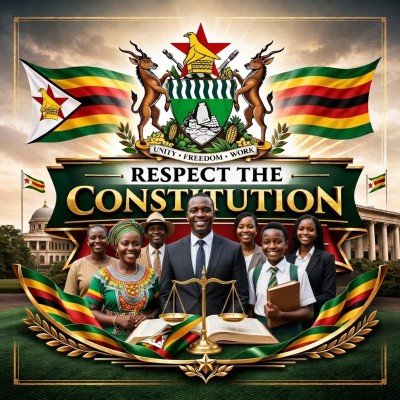
 Zimbabwe Belongs to Its People: Why Democracy, Accountability and Change Matter
Zimbabwe is a country with enormous potential. It has fertile land, valuable minerals, talented people and a population that has repeatedly demonstrated resilience in the face of economic and political hardship. Yet, for millions of Zimbabweans, the promise of a better future remains unfulfilled.
For decades, ZANU-PF has dominated Zimbabwean politics. The party has governed the country since independence in 1980. The question Zimbabweans must now ask is not simply who has governed the country for the longest, but whether the political system is genuinely giving citizens a meaningful opportunity to choose the government they want. Democracy cannot simply mean holding an election every few years. Democracy must mean that citizens are free to organise, campaign, criticise those in power and ultimately remove a government through a credible and peaceful vote.
The 2030 Question
The controversy surrounding President Emmerson Mnangagwa’s extension to 2030 has intensified this debate. In July 2026, Mnangagwa signed constitutional amendments that postponed the next presidential election and extended his tenure to 2030. The amendments also removed the direct election of the president by citizens, giving Parliament the responsibility of choosing the president. Critics have argued that these changes weaken the principle that Zimbabweans should directly choose their national leader. (AP News)
This should concern every Zimbabwean, regardless of political affiliation.
A president should not remain in office simply because the political system has been changed to make it possible. The people should have the final say. If a government genuinely believes it has delivered for the people, why should it fear giving citizens the opportunity to decide whether it deserves another mandate? Where Are the Resources Going?
Zimbabwe is not a country without resources.
We have gold, platinum, diamonds, lithium, agricultural land and other natural resources. Yet ordinary Zimbabweans continue to experience economic hardship and struggle to access basic public services. The central question is therefore one of accountability: where are the benefits of Zimbabwe’s natural wealth going? Natural resources belong to the nation, not to politicians, political parties or a small group of connected individuals. The extraction and sale of those resources should translate into better hospitals, better schools, reliable infrastructure, employment opportunities, clean water and a stronger economy.
Zimbabweans should not have to watch their country’s resources being exploited while their own communities remain underdeveloped.
This does not mean that every government expenditure is wasteful or that every individual associated with ZANU-PF is corrupt. Those would be claims requiring specific evidence. But it does mean that the government must be willing to answer difficult questions about public money, contracts, natural-resource revenues and corruption allegations. A government that asks citizens to trust it must also be willing to show citizens where their money and resources are going. Healthcare Should Not Be a Privilege - Perhaps nowhere is the failure to deliver basic services more painful than in healthcare.
Zimbabwe has highly skilled doctors, nurses and other healthcare professionals. Many have made enormous sacrifices to serve their country. Yet the public health system continues to face serious challenges, including shortages of medicines, ageing infrastructure, shortages of healthcare workers and increasing costs for patients. (WHO | Regional Office for Africa). Reports in 2026 have continued to highlight staff shortages, particularly among nurses and specialised health workers. (ReliefWeb). This is not simply a political statistic. It affects someone’s mother who cannot get treatment. It affects a child whose family cannot afford medicine. It affects an elderly person waiting for care. It affects doctors and nurses who are expected to work in difficult conditions.
Healthcare should not depend on whether someone is wealthy enough to use a private hospital.
- A government should be judged by how it treats the most vulnerable people in society.
- Zimbabweans Deserve a Choice
- Opposing ZANU-PF does not mean opposing Zimbabwe.
- In fact, political opposition can come from a deep love for the country and a belief that Zimbabwe can do better.
It is possible to respect the history of Zimbabwe’s independence while still demanding accountability from the government that has governed for decades. It is possible to acknowledge the sacrifices made during the liberation struggle while also saying that the younger generations deserve their own opportunity to shape the country’s future.
No political party should be considered permanently entitled to govern.
ZANU-PF should have to earn the support of Zimbabweans at the ballot box like any other political organisation. And opposition parties must also be held to the same standard. They must present credible policies, competent leadership, transparency and a clear plan for rebuilding Zimbabwe. The answer is not simply to replace one political slogan with another. The answer is to build institutions that work. Zimbabwe Needs Institutions, Not Political Personalities
Zimbabwe needs a political system where the Constitution is respected, Parliament holds the executive accountable, courts can operate independently and citizens can criticise their government without fear. The country needs elections in which citizens genuinely believe that their vote matters.
- It needs an independent electoral process.
- It needs journalists who can investigate those in power.
- It needs civil society organisations that can operate freely.
- And it needs politicians who understand that public office is a responsibility, not personal property.
- The future of Zimbabwe should not depend on one individual remaining in power.
- A Different Future Is Possible
Zimbabwe does not have to remain trapped in a cycle where political power is concentrated in the hands of the same ruling establishment while ordinary citizens continue to struggle. The country has a young population, talented professionals, entrepreneurs, farmers, teachers, engineers, doctors, artists and millions of hardworking citizens at home and in the diaspora. Zimbabweans have the ability to rebuild their country.
But rebuilding requires accountability.
- It requires leaders who understand that public resources are held in trust for the people.
- It requires healthcare that works.
- It requires jobs and economic opportunity.
- It requires transparent government.
- And above all, it requires a political system in which Zimbabweans are free to decide who governs them.
The demand for political change should therefore not be portrayed as hatred of Zimbabwe or hatred of ZANU-PF supporters. It is a legitimate political position. A citizen should be able to say: I believe the government has failed me, and I want a different government.
That is democracy.
Zimbabwe belongs to its people—not to ZANU-PF, not to the opposition, and not to any individual politician.
The people must remain sovereign.
And if Zimbabwe is to build a better future, the country must move towards a system where leaders earn the right to govern through the freely expressed will of the people, rather than changing the rules to remain in power. Zimbabwe deserves better. Zimbabwe deserves accountability. And Zimbabweans deserve the right to choose their own future.