- Details
- Written by: Munyaradzi Masaka
- Category: Corruption News
- Hits: 56
Zimbabweans Must Not Be Forgotten
Zimbabwe’s decision to donate food supplies to communities in drought-affected Botswana has raised an important question about the country’s own food-security situation: while Zimbabwe is extending a helping hand to its neighbour, are enough
Zimbabweans receiving the help they need at home?
In September 2026, Zimbabwe donated 10 tonnes of food supplies to communities in Botswana’s drought-prone Bobirwa District through ZimAid, the country’s foreign-assistance programme. The gesture demonstrates regional solidarity between neighbouring countries.
However, the government must also confront the reality facing vulnerable Zimbabweans.
The World Food Programme’s 2026 assessment says 35% of Zimbabwe’s urban population is food insecure, while 57% of rural households experience food insecurity during the lean season. WFP also reports that high food prices, limited employment opportunities and economic pressures continue to restrict many households’ ability to obtain adequate food.
FEWS NET has similarly warned that food insecurity could deteriorate through early 2027, with some of the worst-affected areas potentially reaching Crisis (IPC Phase 3) conditions as households exhaust their own food stocks and face high staple prices and reduced incomes.
These figures should not be ignored.
There is nothing inherently wrong with Zimbabwe helping a neighbouring country facing drought. African countries have historically supported one another during difficult times, and humanitarian solidarity is important.
But charity beyond our borders should not distract from responsibility at home.
When families struggle to put sufficient food on the table, when unemployment limits people's ability to buy basic necessities, and when rural households face declining food stocks, government policy must ensure that vulnerable citizens are adequately protected.
The central question is therefore not simply, “Why did Zimbabwe give food to Botswana?” The more important question is: “What is Zimbabwe doing to make sure that no Zimbabwean family is left without sufficient food?”
A government is ultimately accountable for the welfare of the people it governs. Assistance to neighbours can coexist with domestic support, but Zimbabweans have a legitimate right to ask whether resources, policies and social-protection programmes are reaching those who need them most.
Zimbabwe should be able to lend a helping hand to its neighbours without leaving its own vulnerable citizens behind.
The country’s food-security figures provide an opportunity for government to reassess its priorities, strengthen social protection, address unemployment and improve household purchasing power.
The people of Zimbabwe deserve not only promises of a better future, but practical policies that ensure that food, dignity and opportunity are available to them today.
- Details
- Written by: Henry Itayi Makambe
- Category: Corruption News
- Hits: 998
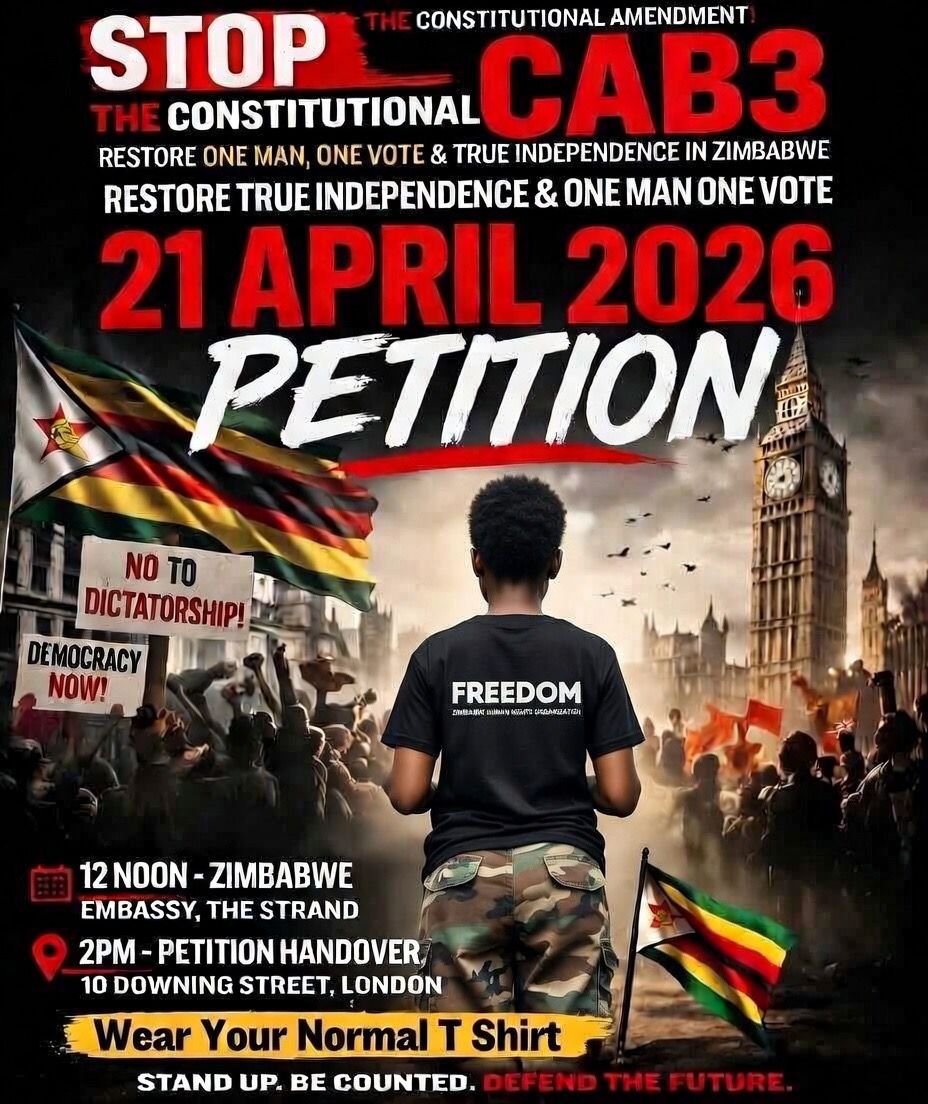 ZIMBABWE WlLL NOT BE SILENCED: DEFEND THE CONSTITUTION
On 21 April 2026 Zimbabweans will rise to say NO to constitutional manipulation and YES to democracy
The proposed amendments known as CAB3 are not just legal changes -- They are a direct threat to our Constitution, our freedoms and the future of our nation.
They risk extending power beyond the will of the people and weakening the very institutions meant to protect us.
We refuse to accept this.
Zimbabwe's Constitution was built through the voices of its people. It must not be reshaped to some political interests.
- Term limits matter.
- Accountability matters.
- Our votes matter.
Across the country and beyond citizens are speaking out despite fear, despite intimidation.
Because this is bigger than politics This is about justice.
This is about protecting the principle of one person one vote
On this day we will deliver a petition that carries one clear message
- -No to dictatorship
- -No to constitutional abuse
- -Yes to democracy
- -Yes to the will of the people
This is a call to every Zimbabwean. Stand up.
Speak out. Be counted
The future of Zimbabwe cannot be decided in silence
- Details
- Written by: Kelvin Mhlanga
- Category: Corruption News
- Hits: 921
 Zimbabwe’s Democracy Is Being Rewritten — And The People Are Being Written Out
Zimbabwe is not witnessing reform. It is witnessing consolidation.
The ruling party, ZANU-PF, is pushing constitutional changes that would extend presidential terms and potentially remove the people’s direct right to elect their president. These proposals are framed as structural adjustments. In reality, they strengthen executive power at a time when democratic safeguards should be reinforced. Extending presidential terms from five to seven years potentially keeping Emmerson Mnangagwa in office until 2030 weakens one of democracy’s core protections: term limits. Term limits exist to prevent power from becoming permanent. When leaders begin adjusting those limits while in office, it raises legitimate concerns about motive.
Even more alarming is the proposal to shift presidential elections from citizens to Parliament. In a legislature dominated by the ruling party, this would effectively remove millions of Zimbabweans from directly choosing their leader. A president selected by politicians instead of voters changes the very nature of accountability but constitutional amendments are only part of the concern. Critics and civil society groups have repeatedly raised questions about the independence of state institutions, particularly the judiciary. Allegations of political influence over judges and key administrative officials have persisted for years. While direct evidence is often difficult to access in a constrained environment, the perception alone damages public trust.
- When court decisions consistently align with ruling party interests in highly political cases, citizens begin to ask whether justice is truly independent or politically aligned.
- Democracy does not collapse overnight. It erodes gradually through legal amendments, institutional pressure, and the quiet weakening of oversight bodies.
- Speaking in Geneva, journalist and activist Blessed Mhlanga warned about this steady erosion of democratic space. His message was blunt: “When leaders begin to fear the ballot, they begin to change the rules.”
He added a sharper line that resonated with many in the diaspora: “A constitution must restrain power not protect it.”
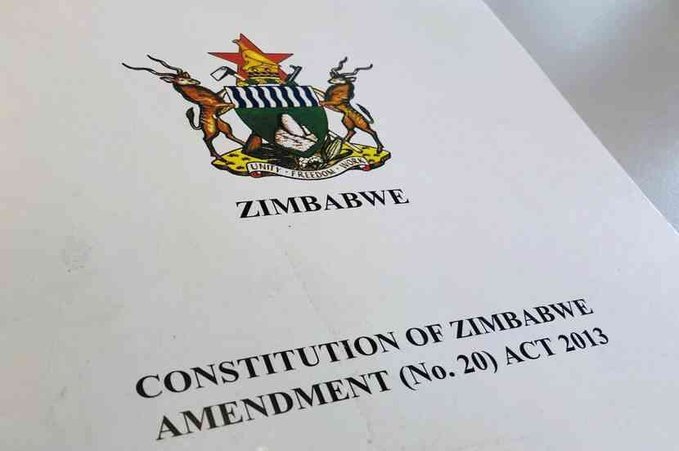
Zimbabwe’s 2013 Constitution was meant to prevent the concentration of authority that defined earlier decades. It was designed as a reset a contract between the state and its citizens. If that contract is now being adjusted in ways that disproportionately benefit those already in power, then the issue is not technical reform. It is democratic regression. The implications stretch beyond Zimbabwe’s borders. Millions in the diaspora whose remittances sustain families and institutions back home remain politically marginalised. Their financial contributions are welcomed, but their political voice remains limited.
History shows that when ruling parties reshape constitutions while questions swirl around institutional independence, confidence in governance declines both domestically and internationally.
The question Zimbabwe now faces is simple:
Is the constitution being strengthened for future generations or reshaped for present leadership?
Because when institutions appear compromised, and when electoral power shifts away from the people, democracy stops being a system of accountability.
It becomes a system of control.
- Details
- Written by: Directed by John Burke, Research by GROK 4
- Category: Corruption News
- Hits: 614
 Overview of Corruption in Zimbabwe
https://x.com/i/grok/share/ssVZOi5iYV2XiTxXhgXuFPoXQ
Zimbabwe continues to grapple with systemic corruption under President Emmerson Mnangagwa's administration, which has exacerbated economic instability, eroded public trust, and hindered development. Despite promises of reform since the 2017 coup, issues like currency manipulation, elite patronage, infrastructure neglect, and electoral manipulation persist. International bodies such as the IMF and U.S. Treasury have highlighted these problems, with the latter imposing sanctions on Mnangagwa and associates in 2024 for corruption and human rights abuses tied to elections. Transparency International ranks Zimbabwe 149th out of 180 countries on its 2024 Corruption Perceptions Index, scoring 24/100, reflecting entrenched graft in public procurement, resource allocation, and political loyalty schemes. Below, I break down the specified areas based on verified reports from credible outlets.
ZiG Currency Crisis
The Zimbabwe Gold (ZiG), introduced on April 8, 2024, as a gold-backed currency to replace the unstable Zimbabwean dollar, aimed to curb hyperinflation and dollarization. Backed by $900 million in reserves (including gold and foreign currencies), it initially faced a "crisis" marked by rapid depreciation, black-market premiums exceeding 50%, and public skepticism amid past currency failures. By mid-2025, however, the ZiG has shown deceptive stability: monthly inflation dropped to 0.3% in June 2025 from over 175% in early 2024, with transaction use rising from 26% to 40% of GDP. The IMF praised this in its October 2025 Article IV consultation, crediting tight monetary policy and gold export booms.
- Details
- Written by: John Burke
- Category: Corruption News
- Hits: 877
 The international community has responded to Zimbabwe's human rights abuses through various measures and actions:
1. Sanctions and Targeted Measures: The European Union, United Kingdom, and United States have imposed targeted sanctions on individuals and entities responsible for human rights violations in Zimbabwe[3]. These sanctions aim to pressure the government to improve its human rights record.
2. Diplomatic Pressure: International bodies and governments have consistently called on Zimbabwe to address human rights concerns. For instance, in 2021, the EU, UK, and US called for investigations into the abduction and torture of opposition members[2].
3. UN Special Procedures: United Nations special rapporteurs have expressed concerns about Zimbabwe's human rights situation. In December 2021, four UN special rapporteurs jointly commented on the potential negative impacts of Zimbabwe's Private Voluntary Organizations Amendment Bill on civil and political rights[3].
4. Human Rights Monitoring: Various international organizations, including Human Rights Watch and Amnesty International, regularly document and report on human rights abuses in Zimbabwe[2][3].
5. Calls for Reform: The international community has repeatedly urged Zimbabwe to implement political reforms, restore the rule of law, and respect fundamental freedoms[1][3].
6. Commonwealth Membership Considerations: Zimbabwe's potential return to the Commonwealth has been scrutinized due to its human rights record, with arguments that the country does not meet the required standards for readmission[4].
7. Advocacy for Investigations: There have been calls for swift, thorough, and credible investigations into specific incidents of human rights violations, such as the abduction and torture of opposition members[2].
8. Criticism of COVID-19 Response: The UN High Commissioner for Human Rights expressed concern about allegations that Zimbabwean authorities may be using the COVID-19 pandemic as a pretext to suppress freedoms[2].
 Despite these responses, some international actors, such as the African Union chairperson and a UN special rapporteur, have called for the lifting of sanctions, claiming they negatively impact living conditions in Zimbabwe[3]. This highlights the complex and sometimes conflicting approaches within the international community in addressing Zimbabwe's human rights situation.
Citations:
- [1] https://www.ohchr.org/en/press-releases/2009/10/council-hears-concerns-about-situation-zimbabwe-it-holds-related-debate
- [2] https://www.hrw.org/world-report/2021/country-chapters/zimbabwe
- [3] https://www.hrw.org/world-report/2023/country-chapters/zimbabwe
- [4] https://lordslibrary.parliament.uk/the-commonwealth-zimbabwes-return/
- [5] https://www.amnesty.org/en/wp-content/uploads/2023/09/AFR4672212023ENGLISH.pdf
- [6] https://www.state.gov/reports/2022-country-reports-on-human-rights-practices/zimbabwe/
- [7] https://zw.usembassy.gov/2020-human-rights-report-zimbabwe/
- [8] https://www.gov.uk/government/publications/zimbabwe-country-of-concern/zimbabwe-country-of-concern
NGOs play a crucial role in documenting and combating human rights abuses in Zimbabwe, despite facing significant challenges and repression from the government. Their key functions include: