 ZIMBABWE WlLL NOT BE SILENCED: DEFEND THE CONSTITUTION
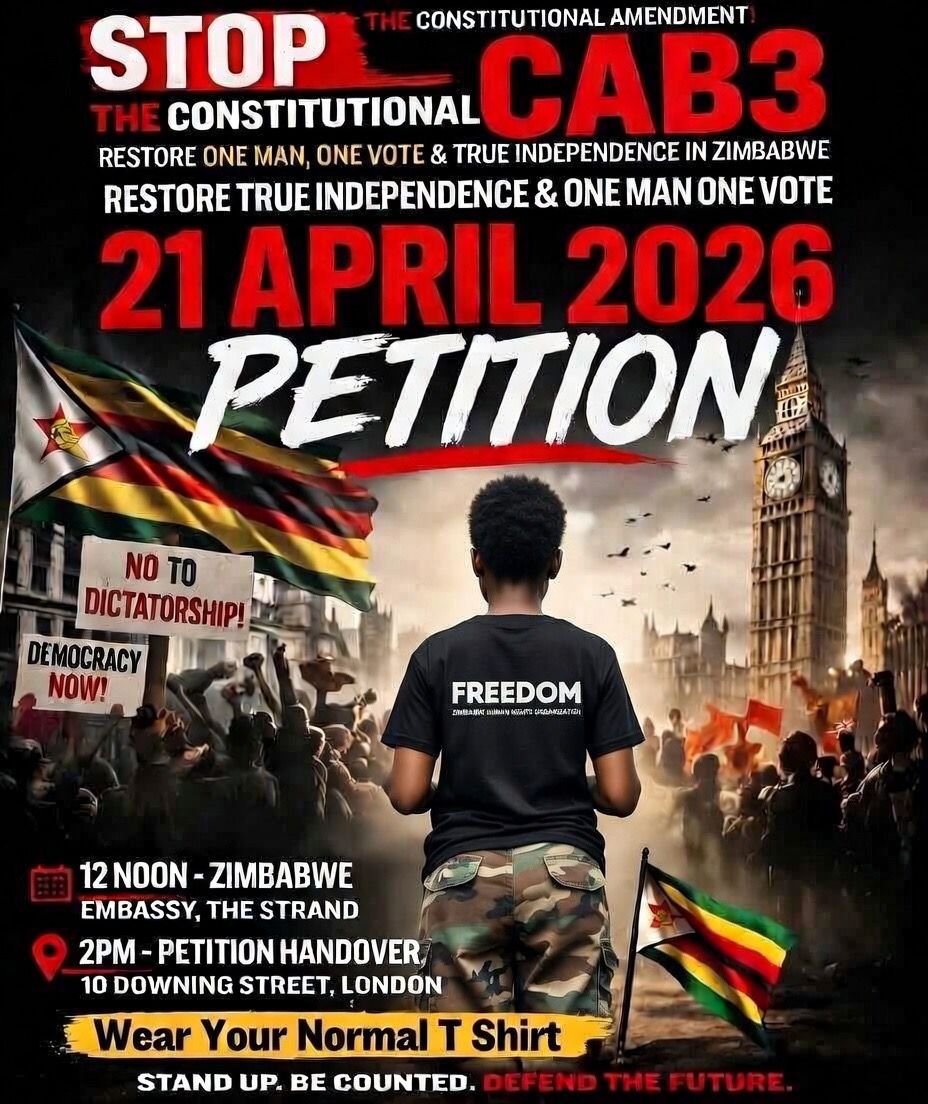
On 21 April 2026 Zimbabweans will rise to say NO to constitutional manipulation and YES to democracy
The proposed amendments known as CAB3 are not just legal changes -- They are a direct threat to our Constitution, our freedoms and the future of our nation.
They risk extending power beyond the will of the people and weakening the very institutions meant to protect us.
We refuse to accept this.
Zimbabwe's Constitution was built through the voices of its people. It must not be reshaped to some political interests.
- Term limits matter.
- Accountability matters.
- Our votes matter.
Across the country and beyond citizens are speaking out despite fear, despite intimidation.
Because this is bigger than politics This is about justice.
This is about protecting the principle of one person one vote
On this day we will deliver a petition that carries one clear message
- -No to dictatorship
- -No to constitutional abuse
- -Yes to democracy
- -Yes to the will of the people
This is a call to every Zimbabwean. Stand up.
Speak out. Be counted
The future of Zimbabwe cannot be decided in silence
APPENDIX: EVIDENCE IN SUPPORT OF THE ZHRO PETITION
The Injustice of CAB3 and the Constitutional Crisis in Zimbabwe
1. What is CAB3? Background and Key Facts
The Constitution of Zimbabwe Amendment (No. 3) Bill, 2026 — formally designated House Bill 1 of 2026 and known colloquially as CAB3 — was gazetted on 16 February 2026 by the Speaker of Parliament following Cabinet approval under the chairmanship of President Emmerson Mnangagwa himself. It represents the most sweeping proposed changes to the 2013 Constitution since that constitution was adopted following years of multi-party negotiation and a public referendum.
The Bill is closely linked to the ZANU–PF party’s “2030 Agenda”, adopted at their 2024 annual conference in Bulawayo. President Mnangagwa’s second and constitutionally final term of office is due to expire in 2028. He will be 86 years old at that point. Despite publicly denying ambitions to remain in office beyond that term, his government has now tabled legislation that would extend his tenure by two years to 2030 and fundamentally alter the constitutional architecture of Zimbabwe.
2. The Principal Provisions of CAB3 and Their Democratic Consequences
Abolition of the Direct Presidential Election
Perhaps the most consequential single clause of CAB3 eliminates the direct popular election of the President of Zimbabwe, replacing it with election by a joint sitting of Parliament. In practical terms, this means the ordinary citizen would no longer vote directly for their head of state. Given that ZANU–PF holds a parliamentary supermajority — secured following a series of controversial opposition recalls — this change entrenches the ruling party’s grip on executive power without any requirement to win the support of ordinary voters. The Zimbabwe Human Rights Commission (ZHRC) itself warned that removing the electorate from the direct presidential vote risks diminishing popular sovereignty and weakening public trust in institutions.
Extension of Presidential and Parliamentary Terms
CAB3 proposes extending presidential, parliamentary and local authority terms from five to seven years. The effect on President Mnangagwa personally is to prolong his existing second term by two additional years, postponing any election from 2028 to 2030. Under the country’s own constitution as it currently stands, term limits are an entrenched provision. Senior constitutional lawyers, including Douglas Coltart — who himself participated in drafting Zimbabwe’s 2013 Constitution — have argued that any amendment affecting the term of the incumbent president requires approval through a national referendum under Sections 328(7), (8) and (9) of the Constitution. The government has resisted this interpretation. Critics have described the government’s approach as an attempt to manipulate constitutional provisions in order to circumvent the will of the people.
Dismantling of Independent Oversight Bodies
CAB3 proposes the abolition of two independent constitutional commissions: the Zimbabwe Gender Commission and the National Peace and Reconciliation Commission, transferring their functions to the Zimbabwe Human Rights Commission. It also transfers authority over the voters’ roll from the Zimbabwe Electoral Commission (ZEC) — established precisely to provide impartial electoral oversight — to the Registrar-General, an office under direct executive control. Opposition leaders and civil society groups have warned that this shift could enable manipulation of voter registration in future elections. The Bill additionally enlarges the Senate and grants the President power to appoint ten additional senators on the basis of professional skills, expanding executive influence in the upper chamber.
3. A Flawed and Coercive Consultation Process
Section 328(3) of the Constitution triggered a mandatory 90-day public consultation period when the Bill was gazetted. Public hearings were held between 30 March and 4 April 2026 — just four working days to cover an entire nation of over 15 million people. Harare, a city of three million inhabitants, was allocated only three hearing venues; Bulawayo, Zimbabwe’s second largest city with over 700,000 residents, was given just two. Legal experts and civic organisations condemned the process as fundamentally inadequate.
The hearings themselves were marred by serious and well-documented abuses. The Alliance for Community Based Organisations (ACBOs) compiled a report drawing on observations from 51 hearing venues across Zimbabwe. Its findings concluded that while attendance was high in many areas, high turnout did not guarantee meaningful participation. Participants were reportedly denied access to venues, prevented from speaking, or discouraged from expressing dissenting views. The Zimbabwe Human Rights Commission — Zimbabwe’s own constitutional human rights watchdog, which deployed monitoring teams across all provinces — documented a pattern of rights violations at multiple venues, including the use of men armed with whips to vet participants in Mashonaland West. The Commission found that people with views differing from the proposed amendments were threatened and silenced.
At the Nketa Hall in Bulawayo, a woman who opposed the Bill was chased from the venue and assaulted outside with stones while police reportedly stood by. A journalist and a lawyer were assaulted during proceedings. Students in Bindura and young people in Bulawayo and elsewhere were reported to have been abducted. Major civil society groups — the Defend the Constitution Platform, the Constitution Defenders Forum, the National Constitutional Assembly and the Amalgamated Rural Teachers Union of Zimbabwe — formally withdrew from the process, describing the hearings as a theatre of coercion that had entirely departed from the spirit and letter of the Constitution. The ARTUZ stated the hearings had degenerated into ruling party rallies, with participants bused in to manufacture the appearance of consent.
4. International Human Rights Organisations Speak Out
Human Rights Watch published a detailed report in March 2026 documenting violence and intimidation against opponents of the presidential term extension stretching back to October 2025. On 28 October 2025, the offices of the Southern African Political Economy Series Trust in Harare were badly damaged in a suspected arson attack, hours before a planned civil society dialogue on Zimbabwe’s constitutional crisis. A suspected ZANU–PF arsonist reportedly abducted the night guard before the attack. Human Rights Watch called on Zimbabwe’s leaders to demonstrate commitment to the rule of law by respecting the constitution and international human rights obligations for freedom of expression and assembly, stating that civil society, legal experts and ordinary people should be permitted to express their views without fear.
Amnesty International, in a statement issued ahead of the public hearings, urged the Zimbabwean authorities to guarantee without discrimination the rights to freedom of expression and peaceful assembly. Amnesty noted that key opponents of the Bill — including the National Constitutional Assembly’s Lovemore Madhuku and the Constitution Defenders Forum’s Tendai Biti — had been arrested, detained and assaulted. The organisation warned that restriction of public debate shuts down genuine participation, accountability and the rule of law, and that past incidents of violence and suppression of dissenting voices made concrete action to guarantee safety a necessity.
International IDEA, in an analysis published in March 2026, described CAB3 as exemplifying executive consolidation through constitutional disruption. The analysis noted that the cumulative effect of the Bill’s provisions represents a fundamental reordering of Zimbabwe’s constitutional system, increasing presidential authority while weakening mechanisms for popular participation and democratic accountability. The author observed that it remained technically possible, but highly implausible, that the Bill would be defeated in Parliament given ZANU–PF’s supermajority and the compliance of traditional leaders in the Senate.
5. A Pattern of Constitutional Manipulation: Regional and Historical Parallels
CAB3 is not an isolated event but part of a well-documented continental pattern of what analysts have termed constitutional capture — the use of legal mechanisms to entrench ruling parties against the democratic will of the people. Uganda scrapped its presidential term limits in 2005 and again in 2017. Rwanda held a referendum in 2015 that extended the presidential term of Paul Kagame. Cameroon removed term limits in 2008, entrenching Paul Biya’s decades-long presidency. In each case, constitutional language and formal processes were used to provide a veneer of legitimacy to what was in substance an extension of personal rule. Commentary published in the Mail & Guardian in April 2026 described Zimbabwe as having now joined this pattern, stating that the most enduring threats to democracy often arrive clothed in legality, eroding accountability whilst entrenching power.
6. The Economic Consequences of Democratic Regression
Zimbabwe already ranks in the bottom quartile globally on World Bank Governance Indicators for Rule of Law, Voice and Accountability, and Control of Corruption. Analysis published in April 2026 argues that this is not merely a political assessment but directly translates into higher country risk premiums that every Zimbabwean business and citizen pays through higher borrowing costs, lower private investment, reduced trade credit and limited access to international capital markets. The same analysis argues that nations that fail economically almost always fail institutionally first — and that the question for Zimbabwe is therefore whether CAB3 moves its institutions of governance toward greater or lesser strength as engines of economic development. The ZHRC has further noted that reforms narrowing democratic space directly undermine the economic confidence that the government’s own stated “open for business” agenda depends upon.
7. The Role of ZHRO and the Diaspora Voice
The Zimbabwe Human Rights Organisation (ZHRO), based in the United Kingdom, was formed to promote human rights as set out in the Universal Declaration of Human Rights and subsequent United Nations conventions, specifically in relation to Zimbabwe and the wider SADC region. ZHRO monitors abuses of human rights through on-the-ground member reporting and the testimony of those who have fled Zimbabwe and are seeking asylum in the UK. The organisation obtains and seeks redress for victims of human rights abuse, and it advocates internationally — including through formal petitions delivered to the UK Government at 10 Downing Street, to the Foreign, Commonwealth and Development Office, to the Commonwealth Secretariat, and to the United Nations Office of the High Commissioner for Human Rights.
The ZHRO petition of 21 April 2026 is an act of peaceful, lawful and constitutionally grounded advocacy in defence of Zimbabwe’s own 2013 Constitution. It reflects the voice of Zimbabweans in the diaspora who — because they have left a country in which the government has demonstrably used violence, intimidation, arbitrary arrest and the suppression of free expression to silence dissent — may speak more freely than many of their compatriots at home. It should be noted that the government of Zimbabwe has itself acknowledged this, having intensified its scrutiny of diaspora individuals alleged to be engaging in advocacy activities aimed at publicising events in Zimbabwe. This targeting demonstrates that diaspora advocacy is effective — and precisely why those who value freedom have a duty to continue it.
8. Conclusion: Why This Petition Matters
Zimbabwe’s 2013 Constitution was not handed down by those in power. It was forged through years of negotiation, public consultation and referendum — a genuine expression of what the people of Zimbabwe sought to establish for their nation. It built in term limits, direct presidential elections, independent commissions, separation of powers, and entrenched protections precisely because Zimbabwe’s history had shown what happens when such safeguards are absent. CAB3 seeks to dismantle a number of these protections, under a process that has itself been accompanied by intimidation, violence and the exclusion of dissenting voices.
The petition being delivered on 21 April 2026 carries a simple, lawful and just demand: that the Government of Zimbabwe honour its own constitution, respect the will of its people, uphold the right to peaceful protest and expression, and reject the imposition of constitutional changes that serve the interests of a political minority rather than the citizens of Zimbabwe as a whole. The evidence assembled in this appendix, drawn from the Zimbabwean government’s own institutions, from internationally respected human rights bodies, from constitutional experts, from civic organisations within Zimbabwe, and from the testimony of those living in exile, affirms beyond reasonable doubt that those concerns are grounded in fact, and that the demand for constitutional integrity is both just and urgent.
Principal Sources
- Constitution of Zimbabwe Amendment (No. 3) Bill, H.B. 1 of 2026 (Parliament of Zimbabwe, gazetted 16 February 2026).
- D. Tinashé Hofisi, “Executive Consolidation by Constitutional Disruption: The Constitution of Zimbabwe Amendment Bill No. 3”, ConstitutionNet / International IDEA, 19 March 2026.
- Human Rights Watch, “Zimbabwe: Violence and Intimidation Against Opponents of Presidential Term Extension”, 10 March 2026.
- Amnesty International, “Zimbabwe: Authorities Must Guarantee Free Expression and Safety Ahead of Public Hearings”, March 2026.
- Al Jazeera, “Zimbabweans Fear Planned Constitutional Change Will Kill Political Choice”, 2 April 2026.
- Daily Maverick, “Zimbabwe’s Opposition Withdraws from Violence-Plagued Hearings on Bill to Extend Mnangagwa’s Term”, 1 April 2026.
- Mail & Guardian / Zimbabwe Situation, “Zimbabwe’s Jarring, Phantom Reform”, 11 April 2026.
- Zimbabwe Human Rights Commission (ZHRC), press statement on monitoring of CAB3 public hearings, April 2026.
- Alliance for Community Based Organisations (ACBOs), report on observations from CAB3 hearings across 51 venues, April 2026.
- Zimbabwe Human Rights Organisation (ZHRO), About Us and Zim Updates (zhro.org.uk), various dates 2021–2026.
- The Zimbabwean / Zimbabwe Situation, “Constitution Amendment Bill No. 3: What the Economists Have Not Said”, April 2026.
- World Bank Governance Indicators (most recent available), Rule of Law and Voice and Accountability indicators for Zimbabwe.