
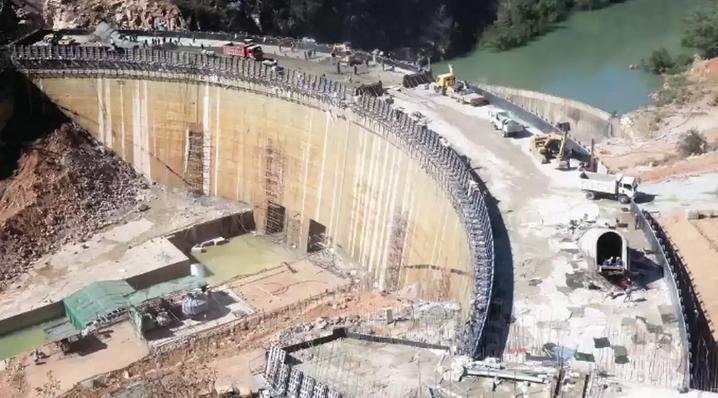
 David Coltart asked a perfect reasonable question {but "fully loaded"} [twitter] regarding this project: "When will it be finished"? which led to many questions - and ultimately led to this detailed analysis and report
We asked: Given our experience with Civil Engineering Projects can you research: Gwayi-Shangani Dam project - Zimbabwe
- With reference to the 1912 concept
- With when physical works were started and relevant details
- History of delays, mistakes, collapse and contractors involved since physical works began
- Any history/evidence of Zanu PF corruption or any kind of interference?
- Recent propaganda claims by the regime or ongoing claims over the decades?
This is a rich and well-documented topic. Let me now compile a comprehensive, structured analysis for you.
Gwayi-Shangani Dam — A Comprehensive Analysis
1. The 1912 Concept & Origins
The idea for the construction of a major dam for the continually drought-stricken Matabeleland Region was first mooted in the early 1900s. An estimate of the cost of such a construction in 1912 was £6,000.
In response to the bedevilling water shortages, the National Matabeleland Zambezi Water Project (NMZWP) was conceived in 1912, encompassing a dam and a pipeline. However, the project remained dormant under settler administration.
The concept was straightforward in engineering terms: the confluence of the Gwayi and Shangani rivers, approximately 6km downstream, offered a natural gorge suited for dam construction. The dam was planned with a holding capacity of 650 million cubic metres, as part of the NMZWP, which aimed to eventually pipe water from the Zambezi River to Bulawayo.
The scheme was never progressed under successive Rhodesian governments despite the worsening water crisis in Bulawayo. In 1993, when the City of Bulawayo was nearly closed down completely due to lack of water, serious and urgent efforts were then made to get things moving. The preference for China ultimately stemmed from the fact that Chinese funding had no political strings attached to it.
2. When Physical Works Began & Key Technical Details
The Gwayi-Shangani Dam commenced in September 2004 [now, 22 years ago] It will be located about 6km downstream of the confluence of the Gwayi River and Shangani River.
2003 — Contract awarded to CIWE (China International Water and Electric Corporation)
2003–2004 — Approximately one year of pre-construction mobilisation: site establishment, access roads, design finalisation with Yellow River Consultancy of China as project designer, and preliminary surveys at the remote Hwange District location
September 2004 — Physical works on site commenced
The project is being funded by the Government through the Public Sector Investment Programme (PSIP) and implemented through the Zimbabwe National Water Authority (ZINWA). China International Water and Electric Corporation (CWE) is the contractor responsible for construction works, while ZINWA is the project manager.
Key technical specifications:
- The dam wall will have an ogee-shaped overflow and a 200-metre long spillway, with a maximum depth of water of 59 metres.
- The planned dam wall height is 72 metres, with 39 metres constructed as of October 2024.
- The project includes a 252km pipeline to Bulawayo and a 122km pipeline from the Zambezi River, plus a 10MW mini-hydroelectric power station.
- The total dam construction cost is approximately US$121.7 million.
Early contractor history: An early phase saw groundwork begun following a $10 billion loan injection from the Reserve Bank of Zimbabwe. A separate proposal surfaced to have the dam financed at US$600 million by the Government of Malaysia, carried out by a joint venture company, Zimbabwe-Malaysia Holdings, with Chinese groundwork contractors also involved. That Malaysian arrangement never materialised.
In July 2012, the Export-Import Bank of China committed to provide Zimbabwe US$864 million for construction of the pipeline component of the NMZWP, at an interest rate of 3% over 25 years, with China Dalian International Economic & Technical Cooperation Group as the project contractor. According to a 2019 report, the Chinese government subsequently abandoned the project, citing Zimbabwe's high risk in infrastructure financing.
3. History of Delays, Technical Problems & Missed Deadlines
This is where the record becomes a damning litany of dysfunction, from an engineering project management standpoint:
2004–2012: The dam was supposed to take 4 years to complete, but two years into construction, there was not much to see at the site — a 300km journey north of Bulawayo.
2012–2016: The China Exim Bank loan was secured but the project stalled repeatedly. The Managing Director of China International Water and Electric Corporation acknowledged financial challenges as the key reason for delay, noting that starting physical wall construction had slipped years beyond schedule. Foreign currency shortages prevented import of equipment parts — the project required between US$8–12 million per year for equipment alone, plus the same again to pay the Yellow River Consultancy of China as project designer.
2019 deadline missed: In 2018, President Mnangagwa, during a tour of the dam, pledged to ensure the project was completed by the end of 2019. In 2019, the dam missed the deadline due to delays and budget constraints and the target was pushed to 2022.
COVID-19 disruption: The contractor's engineers had since December 2019 been held up in China due to COVID-19-induced travel restrictions, halting full-scale construction.
2022 deadline missed: After missing the 2022 deadline, the completion date was further pushed to the end of 2023.
ZIMRA (Zimbabwe Revenue Authority) garnished CIWE's bank accounts four times in the first six months of 2022 alone over non-payment of VAT, which severely disrupted on-site progress. Separately, contract workers went on strike in June 2022 over non-payment of May salaries. Odzi
2023 elections acceleration, then slowdown: Ahead of the disputed August 2023 elections, construction workers were working round the clock as the government sought to present the project as a sign of its capacity to deliver. However, construction work slowed markedly after August. This is a damning observation in engineering and governance terms.
Structural defects identified: By 2025, works underway included treatment of cracks on the dam spillway section and gap grouting of the main dam wall — both remedial operations to address structural integrity concerns. For a dam at only 72% completion to already require crack treatment on its spillway is a serious quality concern.
Funding quantum problem: Deputy Minister Haritatos explained that funding releases in insufficient tranches are effectively useless: "We require four million US dollars for the dam to be raised another two metres. Every two metres costs four million US dollars. If you are given three million nine hundred thousand, it still cannot be raised until we get the full four million. The releases cannot be in drips and drops."
Current status (2025–2026): As of late 2025, the dam had reached 72.1% completion, with contractors operating on a 24-hour schedule after Treasury released US$5 million. The projected completion date has been pushed to February 2027. Construction began in September 2004, with multiple deadlines announced and missed. These repeated postponements have reinforced public perceptions of policy inconsistency and weak project execution.
4. ZANU-PF Corruption, Political Interference & Structural Mismanagement
This section requires distinguishing between documented evidence, credible allegations, and structural political interference — all of which are present.
Deliberate post-independence neglect of Matabeleland: After former President Robert Mugabe, a member of the majority Shona ethnic group, came to power in 1980, the city of Bulawayo saw little in the way of investment, rapidly falling behind the capital Harare, where roads, flashy new buildings, and stadiums were built. This neglect is widely regarded as ethnically and politically motivated, given Bulawayo's Ndebele majority and its alignment with opposition politics.
ZINWA takeover — a political weapon: The situation worsened when the ruling ZANU-PF directed ZINWA to control water management in Bulawayo in 2007. ZINWA, created in the post-independence era to manage water throughout the country, failed dismally after it took over Bulawayo's water resources. This move stripped the opposition-controlled Bulawayo City Council of bulk water rights and handed control to a central government body — a clearly political act with devastating practical consequences.
Political centralisation as the root cause: The Bulawayo water problem is political, says Khumbulani Maphosa, director at the Matabeleland Institute for Human Rights. "It is a question of failed centralisation of power. Local authorities used to have bulk water rights until a centralisation monster called ZINWA was introduced."
Electoral exploitation of the dam: The expected completion of the Gwayi-Shangani dam is widely seen as part of a strategy by Mnangagwa's ZANU-PF to capture votes in the long-neglected second-largest city. ZANU-PF has traditionally struggled to make inroads into urban areas in the province, an area dominated by the minority Ndebele ethnic group. An independent political analyst noted this directly as "a low-hanging fruit politically."
Construction notably accelerated ahead of the disputed August 2023 elections and then slowed markedly afterwards — a pattern consistent with electoral infrastructure manipulation rather than genuine project delivery commitment.
Opposition voices on broken promises: Matabeleland-based opposition Freedom Alliance stated that ZANU-PF had been in power for 43 years but had destroyed even the infrastructure inherited from the colonial government. They warned voters that Gwayi-Shangani promises were as old as the independence struggle itself.
Community displacement without justice: About 502 families will be relocated to pave way for the dam's construction. The Matabeleland Institute for Human Rights raised serious concerns about fair compensation for the people of Lubimbi: "We do not want people of Bulawayo to drink water at the expense of the Lubimbi and the Tonga villagers." Forced displacement of communities — disproportionately rural Tonga and Ndebele people — without adequate compensation is a documented human rights concern.
The Khami Dam body controversy: In the interim, proposals to tap Khami Dam to ease Bulawayo's crisis invoke angry responses, following claims from politicians that the dam contains the bodies of Gukurahundi victims — the mass atrocities of the early 1980s in Matabeleland that killed an estimated 20,000 Ndebele civilians. The unresolved Gukurahundi legacy casts a long shadow over all infrastructure politics in the region.
Many Matabeleland residents associate ZANU-PF with historical marginalisation, unfulfilled development promises, and unresolved grievances, including past state violence and decades of perceived neglect.
5. Propaganda Claims by the Regime
The ZANU-PF and Mnangagwa government's propaganda around this project has been remarkably consistent — and consistently dishonest — across multiple cycles:
Blaming colonialism exclusively: State media routinely frames the project as debunking "the colonial legacy of barrenness," claiming the project remained dormant solely under settler administration while conveniently omitting 44-46 years of post-independence inaction under ZANU-PF itself.
The "Second Republic" narrative: Government narratives consistently claim that "although the project got Government attention in 2016, the coming in of the Second Republic saw it receiving momentous financial support and political will." This ignores that construction began in 2004 under Mugabe's ZANU-PF — the same party.
Repeatedly false completion claims:
- 2021: Promised completion by end of 2021/pipeline by 2022
- 2022: Missed — pushed to end of 2022
- 2023: Missed — pushed to 2023/24 cropping season
- 2024: Missed — pushed to 2025
- 2025: The 2025 target is now in doubt with Treasury still to release funds.
- 2026: The completion target has been moved to February 2027.
Mnangagwa's personal promises: President Mnangagwa stated: "Let me assure you that this National Matabeleland Zambezi Water Project will become a reality during my administration." This has been said at multiple junctures across multiple terms.
The Vision 2030 framing: Provincial minister Richard Moyo calls the dam "a flagship project under the Second Republic and a key component of Vision 2030," framing a chronically delayed colonial-era concept as evidence of Mnangagwa's development vision.
Rejecting emergency measures: The government has rejected calls to declare Bulawayo a water crisis area, which would have enabled the local authority to mobilise financial and material resources from outside the country for short-to-medium term solutions. This refusal — blocking a pragmatic alternative — strongly suggests political rather than technical motivation.
Summary Assessment (Engineering & Governance Perspective)
From a civil engineering project management standpoint, this project represents a near-textbook case of what happens when infrastructure delivery is subordinated to political management:
- Funding mechanism is structurally broken — intermittent Treasury releases make concrete dam wall construction physically impossible (confirmed by the Deputy Minister's own testimony that partial funding below US$4m per lift is worthless)
- Multiple contractor arrangements — Malaysian joint ventures, China Exim Bank loans, CWE/CIWE, China Dalian — indicate no stable, long-term contractual framework has ever been properly established
- Crack treatment and gap grouting at 72% completion indicate quality control failures during construction, likely related to work stoppages that allow concrete to cure partially between pours
- No independent engineering oversight is publicly evidenced — ZINWA acting as both client and project manager is an inherent governance failure
- The pipeline remains largely unbuilt even as the dam wall is still incomplete, meaning even dam completion will not deliver water to Bulawayo for years thereafter
- The project, after 21 years of physical works, remains structurally incomplete — and the latest deadline of February 2027 carries no greater credibility than any of its predecessors